Non-Terrestrial Network (NTN) testing — validating how a cellular device behaves over a satellite link — is now available on the Pico5G Lite, Plus, Pro, and Ultra.1 The capability is delivered as a feature set called Pico5G Satellite, which turns an existing Pico5G bench into a satellite-link test environment without additional hardware. The Pico5G IoT model is 4G-only and does not support NTN.
What It Is
Pico5G Satellite emulates the physical conditions of a satellite link — propagation delay, Doppler shift, orbital motion — while keeping the Radio Frequency (RF), protocol stack, System Information Block 19 (SIB19), Random Access CHannel (RACH), Radio Resource Control (RRC), and device timing computation real.1 The satellite motion is emulated with matching delay and Doppler; everything else runs on live cells. Testing is run against real hardware: a Pico5G User Equipment (UE) emulator, or a real NTN handset or module attached over the air.1
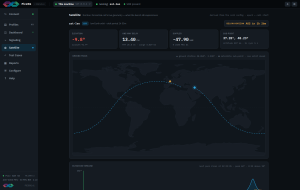
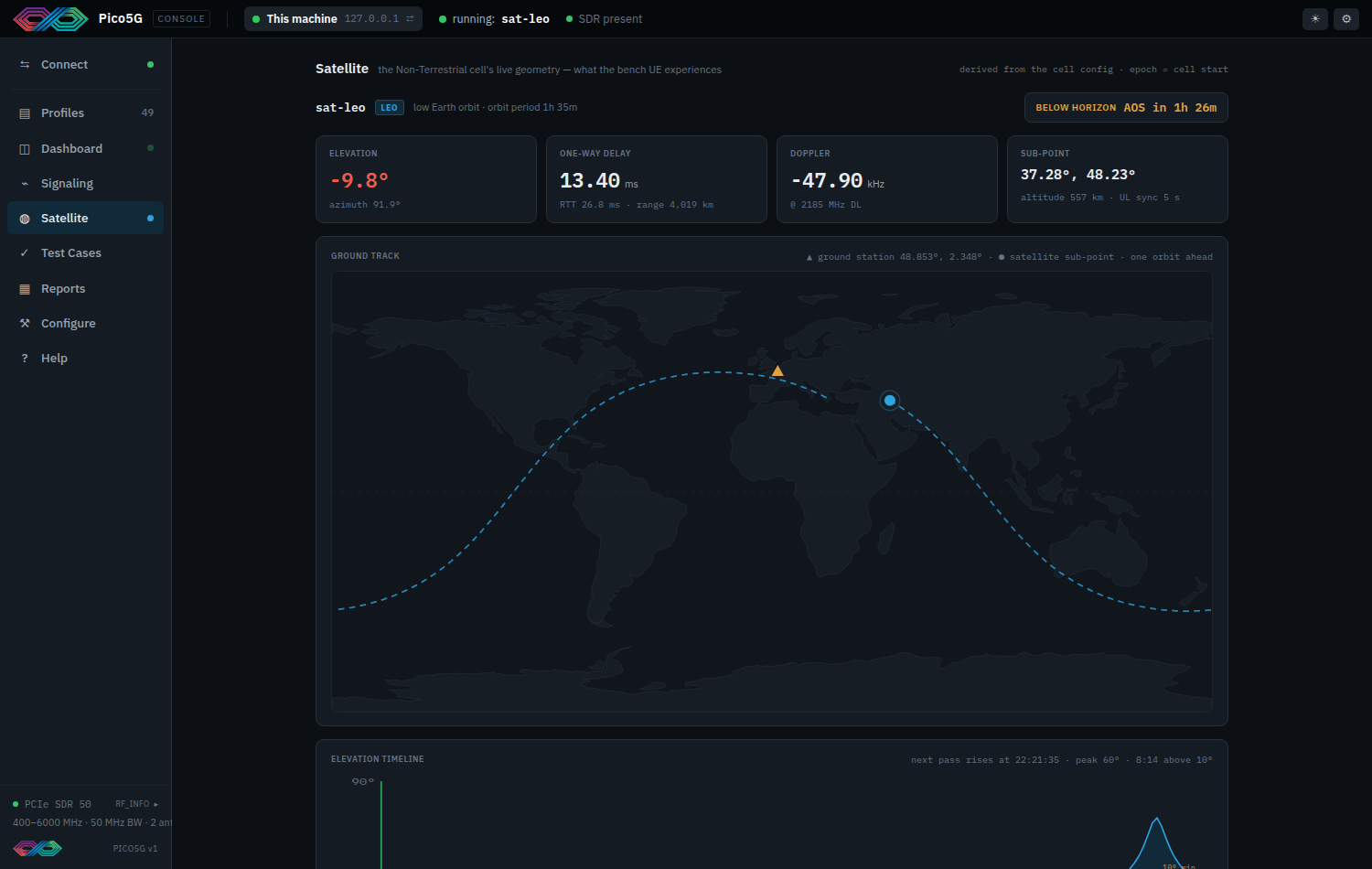
Fig 1. Pico5G Satellite GUI showcasing satellite motion emulation.
The feature supports three orbit classes today:1
- Low Earth Orbit (LEO): ~550 km altitude, 2–6 ms one-way delay, fast passes of a few minutes, and a large Doppler swing
- Medium Earth Orbit (MEO): ~8,000 km altitude, ~28 ms one-way delay, slower passes
- Geostationary Earth Orbit (GEO): ~35,786 km altitude, ~120 ms one-way delay, constant delay, always in view
Both 5G NR NTN and NB-IoT (Narrowband Internet of Things) NTN cells are supported.1
Why It Matters
NTN is no longer a roadmap item. It is in active 3GPP (Third Generation Partnership Project) deployment, and device makers need to validate behavior before launch. The challenge is that real satellite passes are not controllable: elevation angle, Doppler profile, and timing vary with every pass and cannot be repeated on demand. A live LEO pass on a Pico5G bench measured a Doppler swing of ±36 kHz.1 Without emulation, reproducing that condition reliably in a lab is not practical.
The feature also exposes a Global Navigation Satellite System (GNSS)-error axis, letting an engineer feed a device a stale position and observe how uplink pre-compensation degrades.1 That is a failure mode that does not surface in standard RF testing.
What Ships Now
Three tooling elements are available today:1
- Satellite view — A dedicated display showing elevation, azimuth, one-way delay, range, Doppler at the carrier, and the satellite’s sub-point and ground track on a world map, all updating in real time. The Dashboard includes a live satellite strip with a countdown to the next horizon crossing.
- Pass designer — A built-in tool that lets an engineer define a pass by peak elevation, start elevation, and altitude; preview the resulting delay and Doppler profile; and fly it on a live cell. Passes can be time-compressed up to 10× while delay and Doppler remain physically correct.1
Includes ready-made NTN test cases — Each includes a pass/fail verdict:1
- Satellite pass
- Ephemeris re-sync
- Coverage window
In a live bench test, a device re-synced 1 second after an ephemeris update.1
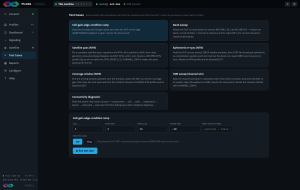
Fig 2. Pico5G Satellite Test Cases
Next Steps
Pico5G Satellite is available now on the Pico5G Lite, Plus, Pro, and Ultra units. If you are developing an NTN-capable device and need to validate connectivity, timing, and protocol behavior before field testing, contact Nutaq to discuss your test requirements.
Not ready to purchase equipment? Nutaq’s Testing as a Service (TaaS) gives you access to professional-grade NTN testing run by Nutaq engineers — no equipment procurement required.
Contact Nutaq to discuss NTN testing for your device →
────────────────────────────────────────────────
Frequently Asked Questions
Q: Which Pico5G models support NTN testing?
NTN testing is available on the Pico5G Lite, Plus, Pro, and Ultra. The Pico5G IoT model is 4G LTE-only and does not support NTN. All four capable models support both 5G NR NTN and NB-IoT NTN cells, and all three orbit classes — LEO, MEO, and GEO.1
Q: Does Pico5G Satellite require a real satellite link or antenna?
No. Pico5G Satellite emulates satellite link conditions — delay, Doppler, and orbital motion — in software on the existing Pico5G hardware. The RF, protocol stack, SIB19, RACH, RRC, and device timing are all real; the satellite trajectory is emulated with physically correct delay and Doppler values. Testing is run against a real device: either a Pico5G UE emulator or a commercial NTN handset or module connected over the air.1
Q: Can I test a specific pass scenario rather than a generic orbit profile?
Yes. The built-in pass designer lets you define a pass by specifying peak elevation, start elevation, and altitude. You can preview the delay and Doppler profile before running it, then fly that exact pass on a live cell. Passes can also be time-compressed up to 10× — useful for iterating quickly — while delay and Doppler values remain physically correct throughout.1
────────────────────────────────────────────────
References
- “5G NTN Testing with Pico5G: Validate NR NTN, NB-IoT NTN.” Nutaq Technologies Inc. May 13, 2026. https://nutaq.com/5g-ntn-testing-pico5g/