
Testing and Private Networks for Manufacturing
Designed for testing, validating, and deploying industrial cellular networks.
Cellular Connectivity Solutions for Manufacturing
Manufacturers are adopting LTE and 5G to connect machines, sensors, mobile assets, and production systems — but deploying cellular connectivity in industrial environments requires careful validation. Our solutions help manufacturers, automation vendors, and system integrators test devices, de-risk deployments, and build reliable private LTE and 5G networks for factory floors and industrial sites.
Built for Industrial Environments
Validate Devices Before Deployment
The compact and portable Pico5G Series of products enables lab-based testing of industrial devices, gateways, and applications against realistic environment, allowing teams to validate connectivity, performance, and interoperability before field deployments.
Private Networks and OT and IT Convergence
The PicoNet supports on-site pilots and operational private LTE/5G networks both indoors and outdoors, providing coverage, reliability, and integration on the factory floor without relying on public networks. Cellular stacks and configurable network architectures bridge the gap between operational technology (OT) and IT.
Empower Your Manufacturing Processes
Smart factory connectivity
Industrial IoT (IIoT) device deployment
Autonomous guided vehicles (AGVs) and robotics
Predictive maintenance and monitoring
Secure wireless connectivity for production systems
Solutions Designed for Manufacturing
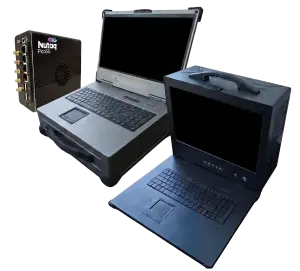
Pico5G provides a complete, standards-based LTE and 5G network in a compact platform, enabling manufacturers and vendors to test industrial connectivity under realistic and repeatable conditions.
Ideal for:
Industrial device and gateway testing
Validation of cellular-enabled machines and sensors
Network behavior and performance testing
Proof-of-concept development for smart manufacturing
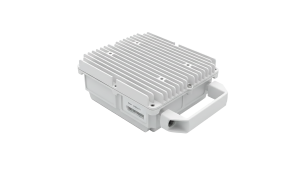
PicoNet delivers local, controlled cellular coverage tailored to industrial environments, and delivering reliable connectivity where Wi-Fi or public networks fall short.
Ideal for:
Factory floors and production lines
Warehouses and logistics facilities
Mobile robots and autonomous vehicles
Pilot and operational private cellular deployments
Build Reliable Industrial Connectivity with Confidence
From early device testing to private LTE and 5G deployment, Nutaq solutions are designed to support the full manufacturing connectivity lifecycle — helping teams modernize operations without compromising reliability.
Related Content

Emulate thousands of User Equipment (UE) to test, validate and optimize LTE and 5G networks in lab or field environments with the Amari Simbox.

Put our engineers and the Pico5G platform to work for you — validating your cellular devices faster, at a fraction of the cost of building your own testing capability.
Full Walkthrough for measuring the PSM Power Profile of the Skyworks SKY66430 NB-IoT and CaT-M1 device.
Understand seven critical IoT device testing mistakes that RF engineers and device manufacturers must address before deployment.
Frequently Asked Questions
A private LTE/5G network is a cellular network deployed and operated by a single organisation for its own use, rather than shared public carrier infrastructure. The operator controls the spectrum, hardware, coverage footprint, security policies, and QoS configuration. By the end of Q3 2025, GSA had identified 1,907 organisations worldwide deploying private mobile networks across 84 countries, with customer references growing at a CAGR of 34% since 2020.1 Manufacturing is the leading sector by number of deployments.1
The main barriers are: spectrum availability and licensing (varies by jurisdiction); integration complexity between OT systems and new cellular infrastructure; total cost of ownership concerns compared to incumbent Wi-Fi; and lack of internal cellular expertise.3 These are best addressed through a phased approach — starting with a pilot deployment in a defined area with a limited device set, validating performance against specific use cases before expanding. Pre-deployment device testing with the Pico5G Series reduces integration risk, while the PicoNet's integrated radio-and-core architecture lowers deployment complexity compared to traditional multi-vendor cellular infrastructure.
Applications that benefit most require mobility, high device density, or performance guarantees that Wi-Fi cannot reliably deliver: autonomous guided vehicles (AGVs) and mobile robotics requiring continuous low-latency links as they move around a facility; high-density sensor networks for predictive maintenance and asset tracking; real-time video monitoring for quality control and safety; remote operation of machinery and cranes; worker safety systems requiring reliable uplink; and OT/SCADA backhaul in facilities where wired connectivity is impractical.2,4
The Pico5G Series is used to validate industrial IoT devices — sensors, gateways, PLCs with cellular interfaces, AGV communication modules, handheld terminals, and machine connectivity adapters — against a controlled LTE or 5G network before they are deployed on the factory floor. Engineers can test attach behaviour, data throughput, latency under load, reconnection after signal loss, and power consumption profiles. This reduces the risk of discovering connectivity issues during production deployment, where troubleshooting costs are significantly higher than in a lab.
Yes. The Pico5G Series supports channel simulation per 3GPP 36.101 and 38.141 specifications, allowing engineers to introduce signal impairments — interference, path loss, bandwidth reduction, packet loss — that reflect the RF conditions found in factories with high-power motors, metallic enclosures, arc welding equipment, and other industrial noise sources. Testing devices against these simulated conditions in the lab builds confidence that connectivity will perform as expected in the actual manufacturing environment.
The PicoNet is a private LTE/5G small cell solution that integrates the radio access network and core network in a single unit, simplifying deployment and reducing infrastructure footprint. It supports LTE and 5G NR across a broad range of frequency bands, delivers up to 50 MHz bandwidth with 2×2 MIMO and up to 2×10 W transmit power for robust indoor and outdoor coverage. On the factory floor, PicoNet units can be positioned to provide contiguous coverage across production zones, warehouses, and loading areas, with the network operated entirely under the facility owner's control.
Because the PicoNet is privately operated, its security policies, QoS rules, and routing can be configured to keep OT traffic separated from corporate IT networks while still enabling integration where required. The PicoNet runs on Ubuntu OS, enabling direct deployment of lightweight edge applications on the same infrastructure. This converged architecture reduces the number of separate network segments and gateways that typically complicate OT/IT integration.
A practical approach has three stages. First, use a Pico5G model in the lab to validate the specific devices, sensors, or gateways planned for the deployment. Second, deploy a PicoNet pilot covering a single production zone or warehouse area, connect the validated devices, and measure performance against the target use case. Third, expand coverage and device count based on validated results. This phased approach mirrors the pattern adopted by many of the 1,907 organisations now deploying private networks globally, which increasingly show a shift from single-site pilots to multi-site operational rollouts.1
Yes. Nutaq offers solutions across the full manufacturing connectivity lifecycle. The Pico5G Series supports device validation from early development through ongoing regression testing. The PicoNet supports pilot and operational private LTE/5G deployments at industrial sites. Both products are supported with training, configuration assistance, and support packages. Contact Nutaq to discuss your project.
Citations
- Global Mobile Suppliers Association (GSA), “Private Mobile Networks December 2025.” By end of Q3 2025, GSA had identified 1,907 organisations worldwide deploying private mobile networks with a contract value above €100,000, spanning 84 countries. Customer references have grown at a CAGR of 34% since 2020. Manufacturing continues to be the leading sector by number of deployments. https://gsacom.com/paper/private-mobile-networks-december-2025/
- SNS Telecom & IT, “Private 5G Market: 2025–2030 — Opportunities, Challenges, Strategies & Forecasts,” August 2025. Projected annual investments in private 5G to surpass $5 billion by end of 2028 at ~41% CAGR. “Industrial giants experiencing patchy Wi-Fi coverage, cabling-related inflexibility, and network scalability limitations … are championing the private 5G movement.” https://www.snstelecom.com/p5g
- ARC Advisory Group, “Private 4G/LTE and 5G Networks in 2025: Key Trends, Growth Drivers, and Market Insights,” September 2025. Manufacturing leads private network deployments globally; barriers include limited awareness, weak ROI justification, and lack of spectrum. https://www.arcweb.com/blog/private-4glte-5g-networks-2025-key-trends-growth-drivers-market-insights
- SNS Telecom & IT / ResearchAndMarkets, “Private LTE & 5G Network Ecosystem 2025–2030.” Notes Tesla eliminated AGV stoppages at Gigafactory Texas; Peel Ports achieved 10× network performance improvement over Wi-Fi at the Port of Liverpool. https://www.researchandmarkets.com/reports/4850170/private-lte-and-5g-network-ecosystem-2025-2030