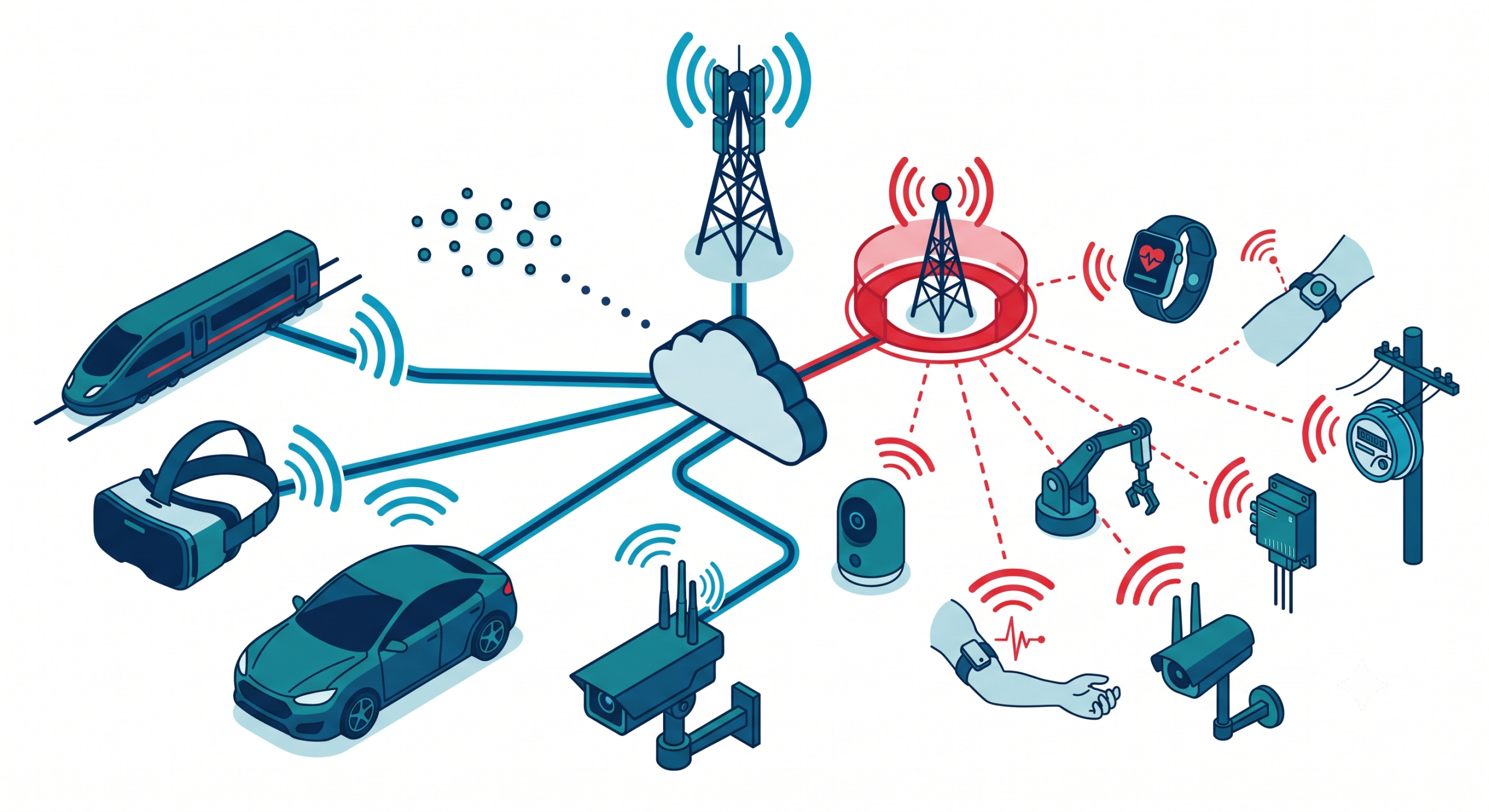
RedCap (Reduced Capability NR), standardized in 3GPP Release 17, is one of the more practically significant additions to the 5G ecosystem in recent years. It defines a class of 5G New Radio (NR) devices that deliberately trade peak performance for lower modem complexity, reduced power consumption, and lower bill-of-materials cost — without falling back to LTE-M or NB-IoT (Narrowband IoT). For device engineers, that design tradeoff creates a specific and non-trivial set of testing requirements.
Commercial RedCap momentum is building. The first GCF (Global Certification Forum)-certified RedCap module — the Quectel RG255C-GL — received certification in September 2024. AT&T launched nationwide RedCap coverage in July 2025. Apple Watch Series 11 launched with RedCap support in fall 2025. These milestones signal that RedCap is moving from specification to deployed product, and the test infrastructure needs to keep pace.
This article covers what RedCap and eRedCap (enhanced RedCap) define at the RF layer, which test scenarios matter most, and how the Pico5G Series supports 5G RedCap device testing in a lab environment.
What RedCap and eRedCap Define
RedCap sits between full 5G NR and the LPWAN (Low Power Wide Area Network) technologies LTE-M and NB-IoT. Key capability constraints defined in 3GPP Release 17 include:1
- Maximum bandwidth: 20 MHz in sub-6 GHz (FR1), compared to up to 100 MHz for full NR UEs (User Equipment)
- Receive antennas: 1 or 2 Rx antennas (vs. up to 4 for standard NR)
- Half-duplex operation: Optional — allows simpler, lower-cost RF front ends
- No carrier aggregation — simplifies modem design further
The net result is a modem that is meaningfully less complex and less expensive than a full 5G chip, while still supporting 5G SA (Standalone) and NSA (Non-Standalone) architecture, NR air interface protocols, and 5G core network procedures.
eRedCap, introduced in 3GPP Release 18, defines an even more constrained variant: peak downlink rate capped at approximately 10 Mbps, FR1 only. It targets the same mid-tier IoT space but extends further down toward the complexity floor.
Target Use Cases for RedCap Devices
The capability profile of RedCap maps to several well-defined vertical use cases:
- Industrial wireless sensors — need reliable low-latency connectivity but not LTE-class throughput
- Video surveillance cameras — require more bandwidth than NB-IoT but not full NR rates
- Medical wearables — prioritize battery life and compact modem size
- Asset tracking — benefit from 5G coverage with a power-efficient radio
- Smart grid telemetry — predictable, periodic data with long device lifetimes
What these use cases share is a need for more than LPWAN can deliver, but a strong incentive to avoid the cost and power draw of a full 5G modem. RedCap is the specified answer to that tradeoff.
Why RedCap Testing Requires a 5G SA/NSA Platform
RedCap devices connect to a 5G NR air interface and a 5G core network. This means testing them requires a platform that can operate as a 5G SA or NSA base station — not just a 4G eNodeB. LTE-M and NB-IoT testers are not applicable here.
Within the Pico5G Series,2 the models that support 5G SA and NSA are the Pico5G Lite, Pico5G Plus, Pico5G Pro, and Pico5G Ultra. The Pico5G IoT is a 4G-only platform (LTE, LTE-M, NB-IoT) and does not apply to RedCap testing.
The Pico5G Series is built on the Amarisoft software stack.2 The Amarisoft stack supports NR SA RedCap including TDD (Time Division Duplex) and FDD (Frequency Division Duplex) duplex modes, half-duplex operation, initial BWP (Bandwidth Part) configuration, NCD-SSB (New Control-Data Synchronization Signal Block), and both single and multiple dedicated BWP configurations.3 The Pico5G Series supports 3GPP Releases 17 through 19,2 which covers RedCap (Release 17) and eRedCap (Release 18).
Key Test Scenarios for 5G RedCap Device Testing
BWP Configuration and Switching
Bandwidth Parts are the mechanism 5G NR uses to allocate a subset of the carrier bandwidth to a UE. For RedCap devices — which are capped at 20 MHz — BWP configuration is particularly important. Three configurations are relevant in practice:3
- Shared BWP — RedCap and non-RedCap UEs share the same BWP. Validates coexistence on a mixed-device network.
- Dedicated RedCap-only BWP — isolates RedCap UEs on their own bandwidth allocation. Confirms the device attaches and operates correctly within a constrained BWP.
- Multiple BWPs with NCD-SSB — tests the device’s ability to locate the cell using a New Control-Data SSB that is positioned within the RedCap BWP, rather than the full carrier SSB.
The Amarisoft tech academy provides a dedicated NR SA RedCap tutorial covering all three configurations.3
Half-Duplex Operation
If the device under test implements optional half-duplex FDD, the test platform must be able to configure and enforce the timing constraints that prevent simultaneous Tx/Rx. Validating correct half-duplex behavior — including any uplink/downlink transition timing — is a distinct test case from standard FDD operation.
Network Access Restrictions
3GPP defines mechanisms that allow a network to restrict access by non-RedCap UEs or, conversely, to bar RedCap UEs from certain cells. Validating that a RedCap device correctly interprets and responds to these access control signals is a protocol conformance requirement.
Power Consumption Profiling
Battery life is a core value proposition of RedCap devices. The Pico5G Series supports PSM (Power Saving Mode) and eDRX (Extended Discontinuous Reception) profiling,2 which are the primary mechanisms used to extend battery life in connected IoT devices. Measuring actual power draw under configured PSM/eDRX cycles in a controlled lab environment is more repeatable and interpretable than field measurements.
Throughput and Signaling Validation
End-to-end throughput testing within the 20 MHz bandwidth constraint — and validation of the full attach, authentication, and data bearer establishment procedure over a 5G core — confirms that the device correctly implements the RedCap capability profile at both the RF and protocol layers.
Conclusion
RedCap occupies a well-defined position in the 5G device landscape: it is not a simplified version of NB-IoT, and it is not a stripped-down full NR modem. It is a distinct 3GPP-specified capability class with its own BWP constraints, duplex options, and network access procedures. Testing it correctly requires a platform that can run 5G SA/NSA, configure BWPs appropriately, and emulate the network behaviors that RedCap devices will encounter in deployment.
The Pico5G Series — specifically the Lite, Plus, Pro, and Ultra models — provides that capability in a lab environment, built on the Amarisoft software stack with support for 3GPP Releases 17 through 19. For teams that need to validate a RedCap or eRedCap device without procuring and configuring their own test equipment, Nutaq’s Testing as a Service (TaaS) is also available.
If you are working on a RedCap device program and want to discuss test requirements, contact Nutaq or visit the Pico5G Series page for platform details. If your timeline or budget makes equipment ownership impractical, explore Testing as a Service as an alternative path.
Frequently Asked Questions
Q: What is 5G RedCap and how does it differ from LTE-M or NB-IoT?
RedCap (Reduced Capability NR), defined in 3GPP Release 17, is a 5G NR device class designed for mid-tier IoT applications. It uses the 5G NR air interface and 5G core network, which distinguishes it fundamentally from LTE-M and NB-IoT — both of which are 4G-based LPWAN technologies. RedCap targets use cases that require more throughput than LPWAN can deliver (e.g., video surveillance, industrial sensors) but do not justify a full 5G NR modem. Key constraints include a maximum 20 MHz bandwidth in sub-6 GHz, 1–2 receive antennas, no carrier aggregation, and optional half-duplex operation.1
Q: Do I need a 5G SA platform to test a RedCap device?
Yes. RedCap devices operate on a 5G NR air interface and require a 5G core network for procedures such as initial attach and authentication. A 4G LTE test platform is not sufficient. Within the Pico5G Series, the Lite, Plus, Pro, and Ultra models support 5G SA and NSA and are applicable for RedCap testing. The Pico5G IoT is a 4G-only platform and does not support RedCap.2
Q: What is NCD-SSB and why does it matter for RedCap testing?
NCD-SSB stands for New Control-Data Synchronization Signal Block. In a 5G network serving both full NR and RedCap UEs, the primary SSB (Synchronization Signal Block) may be positioned outside the 20 MHz RedCap BWP. NCD-SSB is a secondary SSB placed within the RedCap BWP so that RedCap devices can locate the cell without needing to monitor the full carrier bandwidth. Testing NCD-SSB behavior — specifically, that the device correctly detects and attaches using the NCD-SSB — is a required test case for RedCap validation.3
Q: What is eRedCap and which 3GPP release defines it?
eRedCap (enhanced RedCap) was introduced in 3GPP Release 18. It defines a further simplified variant of the RedCap device class, with a peak downlink rate capped at approximately 10 Mbps and operation limited to FR1 (sub-6 GHz). The Pico5G Series supports 3GPP Releases 17 through 19, covering both RedCap and eRedCap.2
Q: What if I need RedCap device testing but am not ready to purchase test equipment?
Nutaq offers Testing as a Service (TaaS), a professional cellular device testing service powered by the Pico5G platform. A Nutaq engineer handles test plan design, execution, and delivers a written report with results and recommendations. It is available for one-time or iterative engagements and includes NDA support. Details and quote requests are available at nutaq.com/taas/.
───────────────────────────────────────────────────────────
References
- “NR RedCap.” 3GPP. Accessed June 2026. https://www.3gpp.org/technologies/redcap.
- “Pico5G Series.” Nutaq Technologies Inc. Accessed June 2026. https://nutaq.com/pico5g-series/.
- “NR SA RedCap.” Amarisoft Tech Academy. Accessed June 2026. https://tech-academy.amarisoft.com/NR_SA_RedCap.html.