
Every orbit. One bench.
A satellite-link test bench built into the Pico5G box you already own. Fly real LEO, MEO and GEO passes over a live 5G NR or NB-IoT cell — with true delay and Doppler — and test real devices over the air.
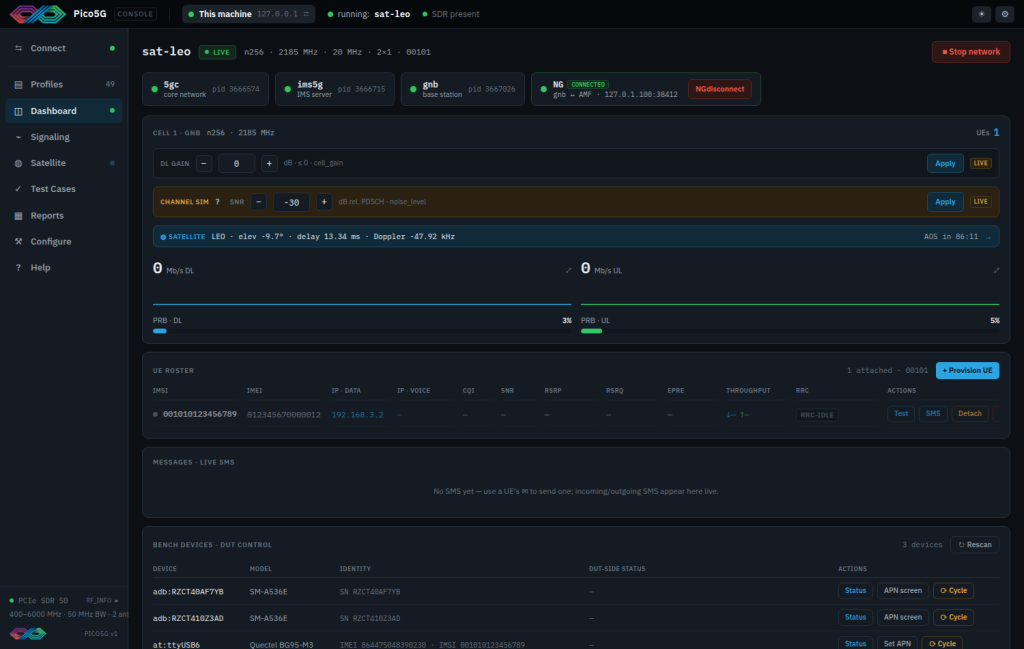
±36 kHz
Doppler swing, live LEO pass
1 s
Device re-sync after ephemeris update
10×
Time compression, physically correct
LEO · MEO · GEO
All three orbit classes
See Exactly What Your Device Experiences
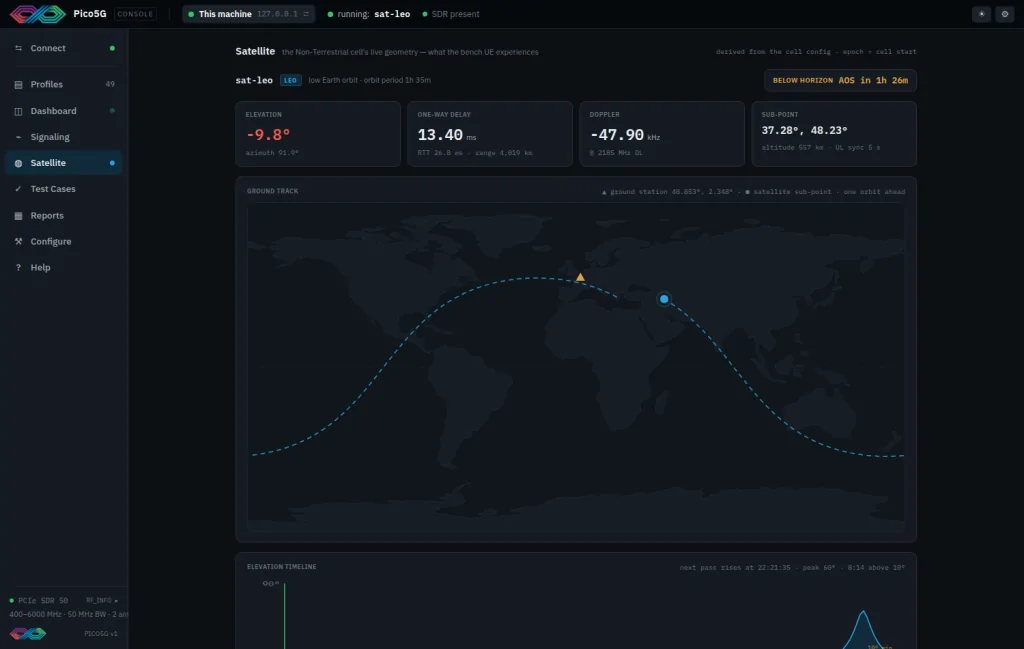
A dedicated Satellite view shows the emulated satellite’s elevation and azimuth, one-way delay and range, Doppler at the actual carrier, and its sub-point on a world map with the ground track for the orbit ahead — all updating in real time while your device rides the pass.
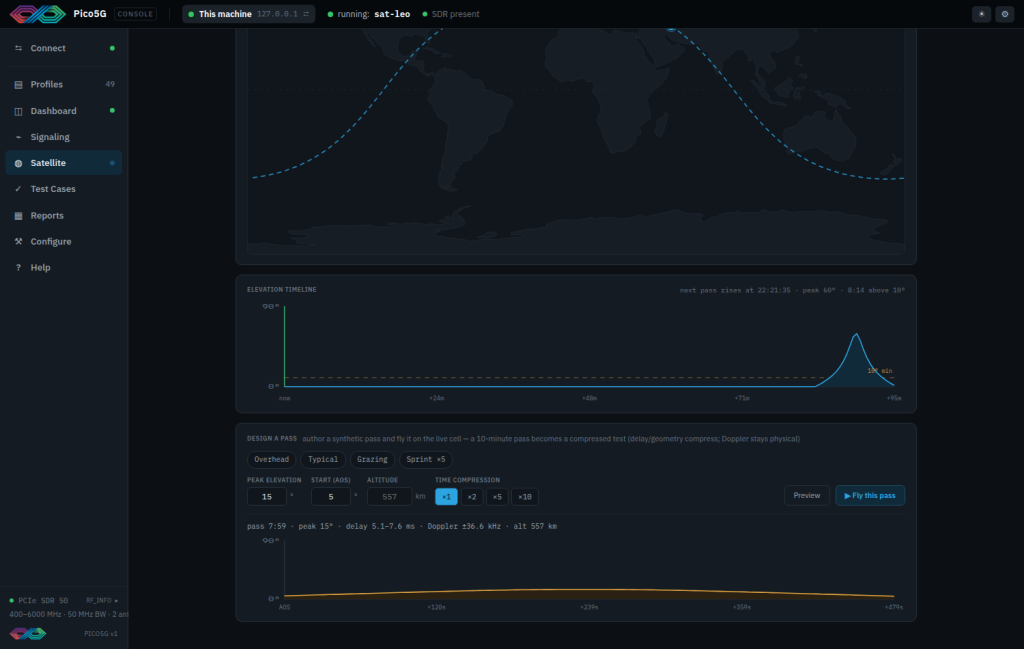
Design a Pass And Fly It On Demand
Real satellite passes happen on the satellite’s schedule. The built-in pass designer lets you author the exact pass you need — peak elevation, start elevation, altitude — preview it, and fly it on the live cell immediately.
Passes can be time-compressed up to 10×. A ten-minute LEO pass becomes a short, repeatable test while delay and Doppler stay physically correct throughout.
Three NTN Test Cases. One Verdict Each.
Deterministic, repeatable procedures that drive the live cell, observe the device, and produce a pass/fail verdict plus a measurement curve — the same result every run, ready for a report or a CI pipeline.
Satellite Pass
Fly a full pass and chart the device against elevation, delay and Doppler, from horizon to horizon.
Ephemeris Re-sync
Step the broadcast ephemeris — as a constellation update would — and time how fast the device re-reads SIB19 and recovers uplink sync.
Coverage Window
End the serving window, watch the device across the coverage gap, then raise the next pass and time the reattach.

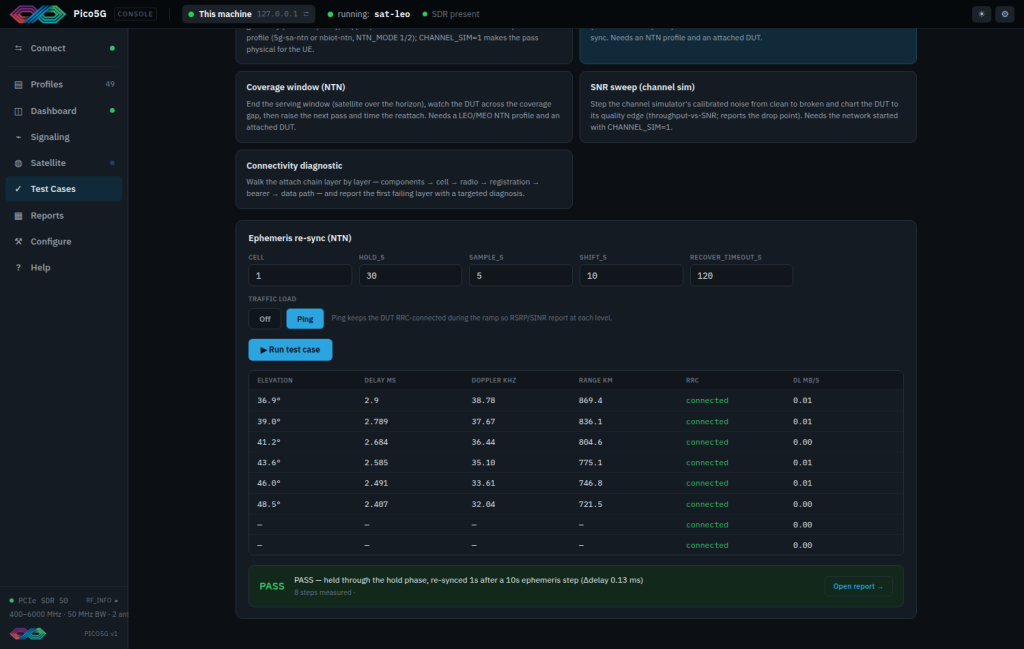
Every figure and screenshot on this page was captured on a live Pico5G bench — a LEO satellite cell with a 5G NR NTN device attached over the air.
The Verdicts Are Earned Against Real Hardware
A Pico5G UE emulator — or a real NTN handset or module — attaches to the satellite cell over the air and rides the pass. The channel simulator applies delay and Doppler to the downlink, so the device sees a genuine satellite link.
The suite even exposes a GNSS-error axis. Feed the device a stale position and watch its uplink pre-compensation degrade — a failure mode standard RF testing never surfaces, and few labs can run cheaply.
Emulated vs. real
| Emulated (physically correct) | Real |
|---|---|
Satellite motion · elevation · azimuth · one-way delay · range · Doppler at carrier | RF signal · full 3GPP stack · SIB19 · RACH · RRC · device timing computation · the device itself |
A RACH or RRC failure during a pass is a genuine device protocol failure — not a test-environment artefact.
Three Orbit Classes On One Bench
| Orbit | Altitude | One-way delay | Behaviour |
|---|---|---|---|
| LEO | ~550 km | ~2–6 ms | Fast passes (minutes), large Doppler swing — the hardest test |
| MEO | ~8,000 km | ~28 ms | Slow passes, non-trivial Doppler and delay variation |
| GEO | 35,786 km | ~120 ms | Always in view, constant high delay |
Supported across 5G NR NTN and NB-IoT NTN cells on the Pico5G Lite, Plus, Pro and Ultra. A full step-by-step engineering guide ships inside the product’s Help.
Point the Copilot at the Pass
The Pico5G Copilot works the satellite bench too. Ask it to bring up an NTN cell, run any of the three NTN test cases, or diagnose why a device lost uplink sync mid-pass, and it answers with cited evidence: the SIB19 read, the RACH attempt, the timing-advance computation, pulled straight from the box’s own trace. NTN failures are exactly the kind of deep, timing-sensitive problems where cited diagnosis beats guesswork. The Copilot is the AI tier, which includes Satellite.
Related Content
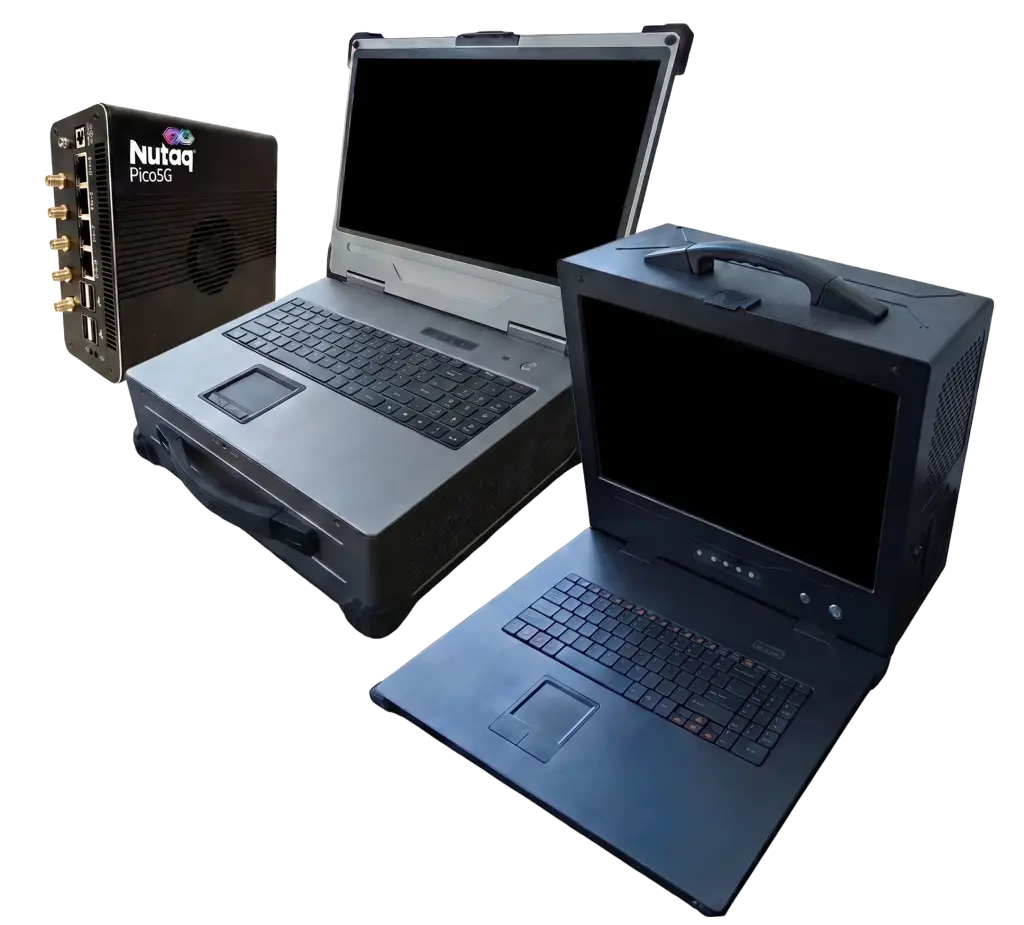
All the functionality and benefits of the next leading cellular testing platform in a portable compact chassis. Offered in multiple models.
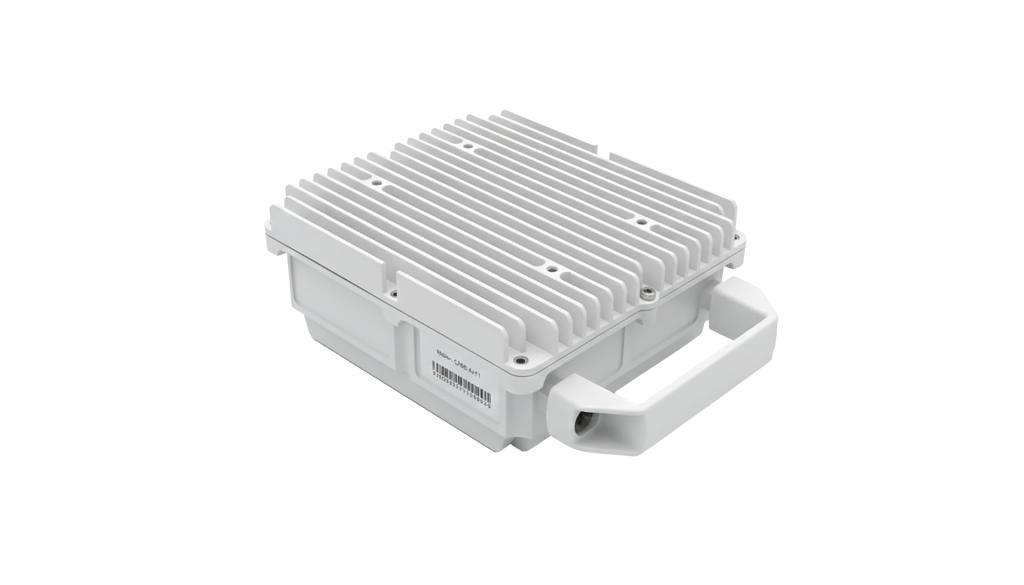
The PicoNet accelerates enterprise and industrial private network deployments with simplicity, flexibility, and carrier-grade performance.
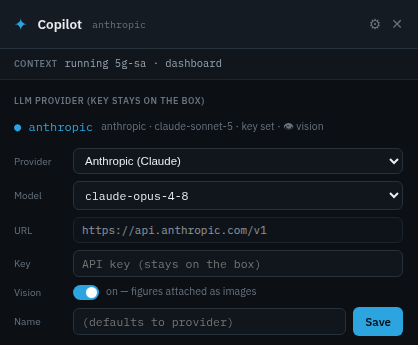
AI test engineer drives the unit’s own tools, reads live signaling, searches 8,000+ documentation sections and answers with citations you can check.
Learn more about the specifications and functionality of the Pico5G Series of products.
Frequently Asked Questions
No. It emulates satellite link conditions — delay, Doppler, orbital motion — on the existing Pico5G hardware. The RF, protocol stack, SIB19, RACH, RRC and device timing are all real; testing runs against a real device attached over the air.
The Pico5G Lite, Plus, Pro and Ultra — all supporting 5G NR NTN and NB-IoT NTN across LEO, MEO and GEO. The Pico5G IoT is 4G-only and does not support NTN.
Yes. Define a pass by peak elevation, start elevation and altitude; preview its delay and Doppler profile; then fly that exact pass on a live cell — optionally time-compressed up to 10×.