
Ask Your Network Anything With the Pico5G Copilot
The Pico5G’s on-box AI test engineer drives the unit’s own tools, reads live signaling, searches 8,000+ documentation sections and answers with citations you can check. Diagnosis with receipts on a complete LTE/5G/NTN network in one box.
58 Seeded-Fault Exam Cases
Spanning diagnosis, capability, refusal and integrity, with every engine rated on the unit
Every Conclusion Cited
Tool result, trace line, or document section
Approval-Gated
Engine-enforced safety outranks even your click
8,000+ Sections
On-box knowledge, 3,400+ figures — air-gap capable
See the Copilot in Action
What the Pico5G Copilot Does Today
Diagnose, With Receipts
Ask in plain language and the Pico5G Copilot drives the box’s own tools, checks a curated fault library built from real bench incidents, diffs your failing against golden reference traces, and searches the on-box corpus — Amarisoft Tech Academy and the ShareTechnote handbook — figures included. Expand the evidence trace under any answer and check its work.
Compose and Run Tests
“Sweep my modem across its Cat-M1 bands” becomes a composed, parameterized, executed and interpreted test campaign, the box even cycles the device’s radio automatically, and finished with a branded evidence report.
Investigator Mode
When no known pattern matches, the Pico5G Copilot keeps digging. Investigator Mode runs multi-layer root-cause hunts, capturing live PHY-to-NAS traces around an event and running bidirectional A/B config experiments that turn a plausible cause into flip-verified evidence, all under the same approval gates and audit log as every other action.
Watch the Bench
Every night, if the bench is idle, the sentinel runs a baseline test and flags drift — deterministically, no AI model in the loop. Bench health stops being a matter of opinion and becomes a log file.
AI-Authored Test Cases
Describe a test in plain language and the copilot drafts a typed, compile-checked Test Script. It only runs after it validates against the box’s own vocabulary and you review the steps, so an AI-written test is held to the same bar as a hand-written one.
Every Engine, Exam-Rated
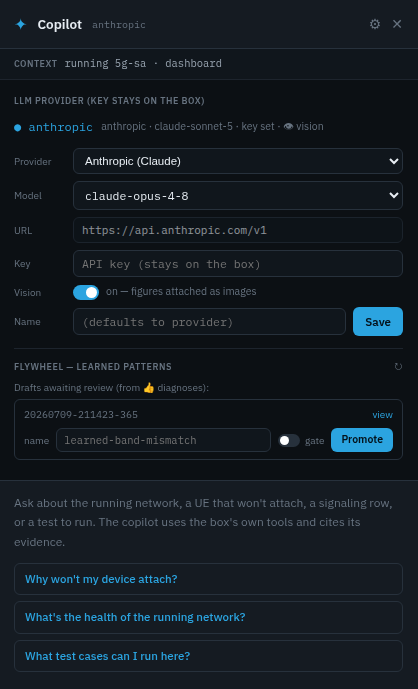
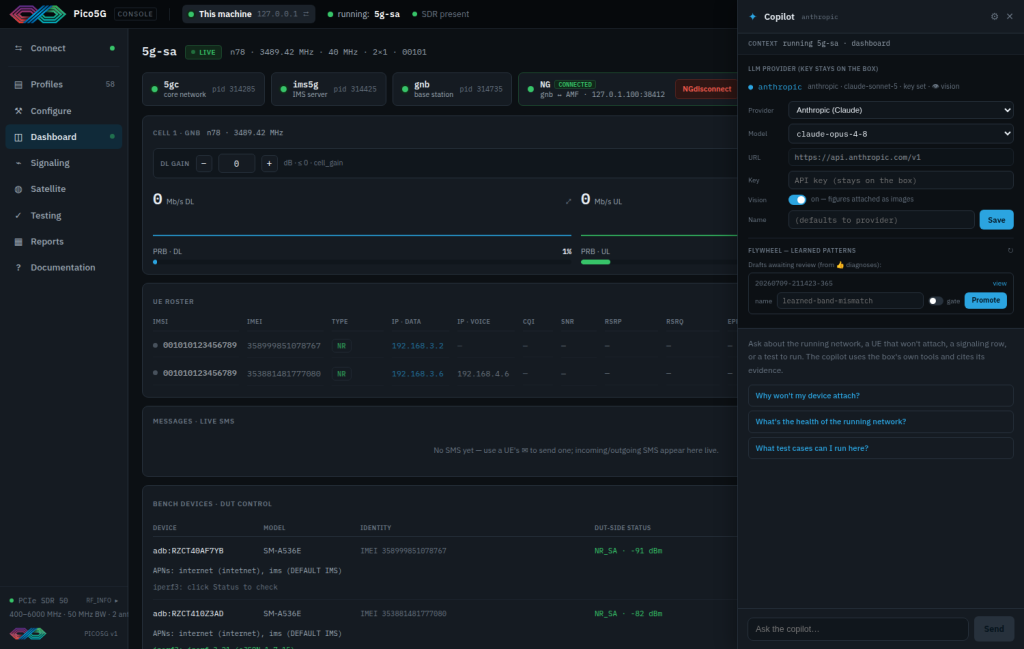
Every provider entry shows its measured exam rating, or the honest label ‘unrated engine’. Ratings are generated from real exam records on the unit, never hand-typed, so you can see how an engine scores before you trust it.
Approval-Gated, Safety-Bounded, And Audit-Logged
The Pico5G Copilot diagnoses read-only. To change anything, such as retune a cell, cycle a modem, or start a test, it stops and asks, naming the exact action and arguments. Your approval isn’t the last word: the unit’s engine-enforced safety policy (TX-gain caps, band allowlists) is checked after you click, so no one — human or AI — talks the box past its limits.
Every state-changing action lands in an append-only audit log with its actor. Prefer advise-only? One policy setting removes the AI’s action tools entirely.
Tested Like Everything Else On the Bench
The Pico5G ships an accuracy benchmark that seeds real faults on the real hardware, asks the copilot the operator’s question, and scores the answer against the known cause. When an ask cannot be expressed or proven on the bench, the copilot refuses with a coded reason instead of faking a pass, and that refusal is measured too: the exam now spans 58 seeded-fault cases across diagnosis, capability, refusal and integrity, including healthy-control and over-refusal cases that prove the copilot neither invents faults on a healthy bench nor refuses work it can actually carry out. The standing quality gate is ≥80%, and no learned knowledge is promoted unless the benchmark still passes. Use the same exam to vet any model, cloud, LAN, or on-box, before you trust it, and see each engine’s measured rating in-product, or the honest label ‘unrated engine’.
What It Can't Do — On Purpose
The Pico5G Copilot cannot act without you. It doesn’t know your device’s proprietary internals. It will not run unattended overnight experiments without authorization. The only thing that runs by itself is the deterministic sentinel, configured by you. And it cannot exceed the radio safety policy, even with your approval.
Model-Agnostic And Air-Gap Capable
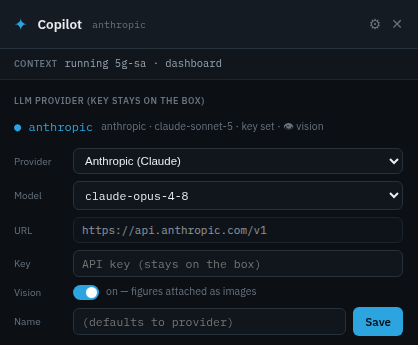
Bring an Anthropic, OpenAI, or GLM key. The AI model is stored on the unit, never displayed back, never sent to the browser, and never seen by support. Or bring no key at all: point the Pico5G Copilot at any OpenAI-compatible model on your LAN or on the box itself. You can also run Claude Code or Codex spawned on the unit under its own login, each in a locked sandbox whose only door out is the box’s own audited tool server. The knowledge corpus, fault library, and golden traces live on the unit and work air-gapped.
62 Tools, Same Rules
The MCP server exposes the same 62 typed tools the GUI and CLI use to any MCP-capable client — Claude Code, Claude Desktop, or your own agent — bounded by the same safety policy, license gating, and audit log.
Where the Pico5G Copilot is Going Next
On the Roadmap
Autonomous Investigator Mode
As a product capability, multi-unit fleet scenarios, and a fully air-gapped on-box model option for secure facilities.
Related Content
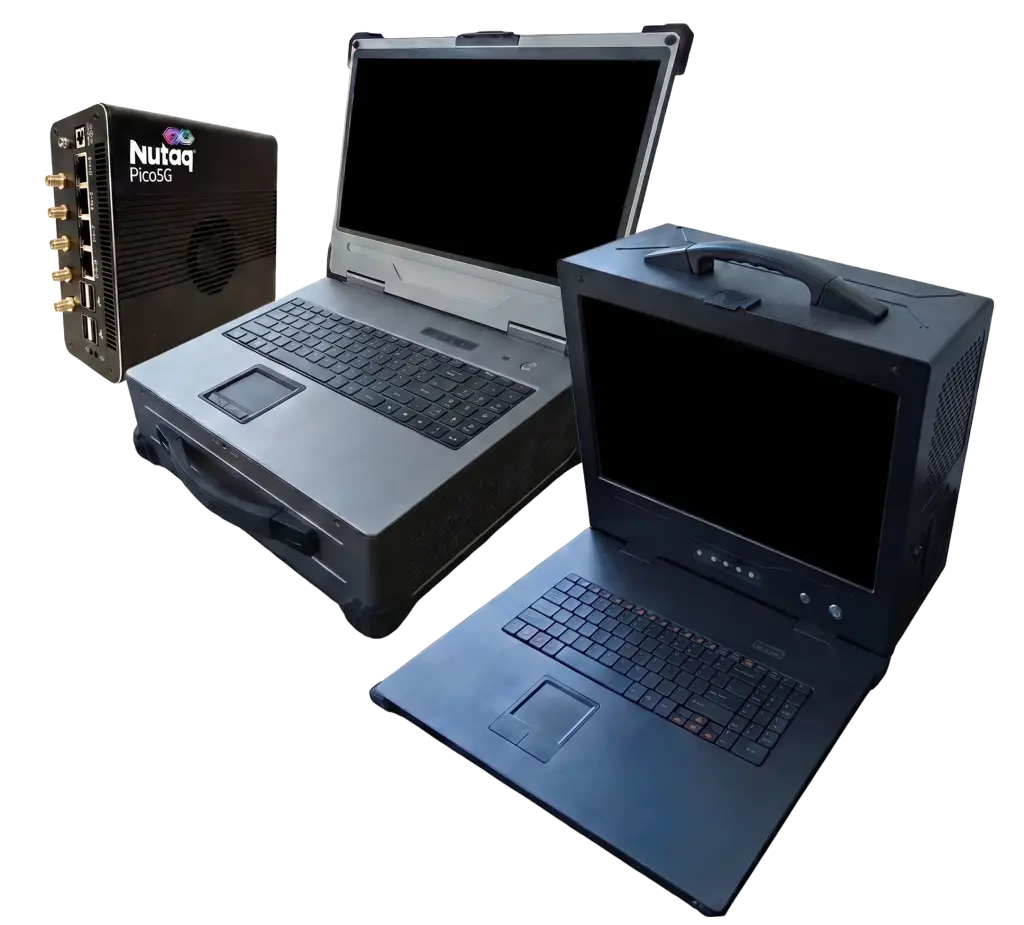
All the functionality and benefits of the next leading cellular testing platform in a portable compact chassis. Offered in multiple models.
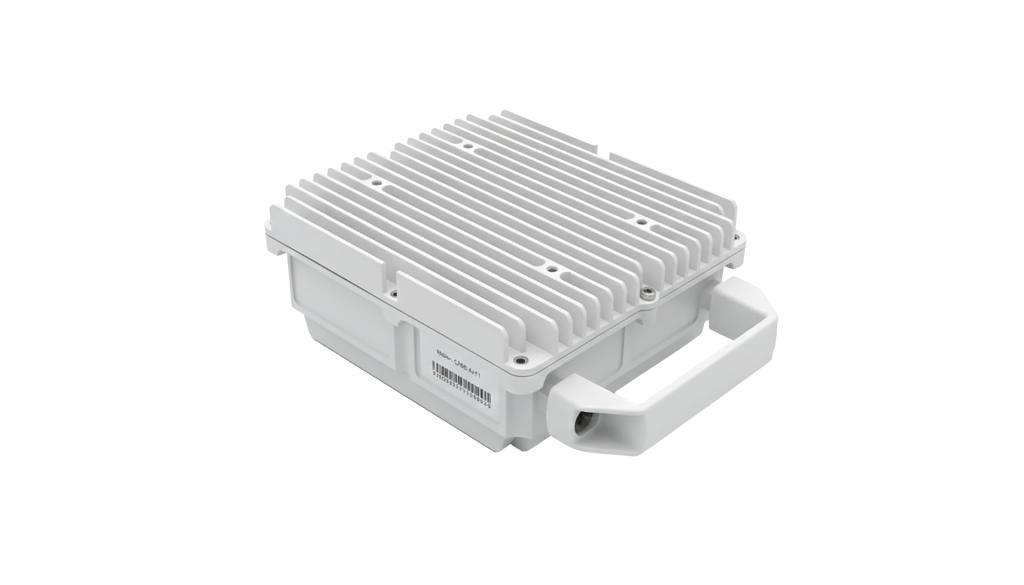
The PicoNet accelerates enterprise and industrial private network deployments with simplicity, flexibility, and carrier-grade performance.
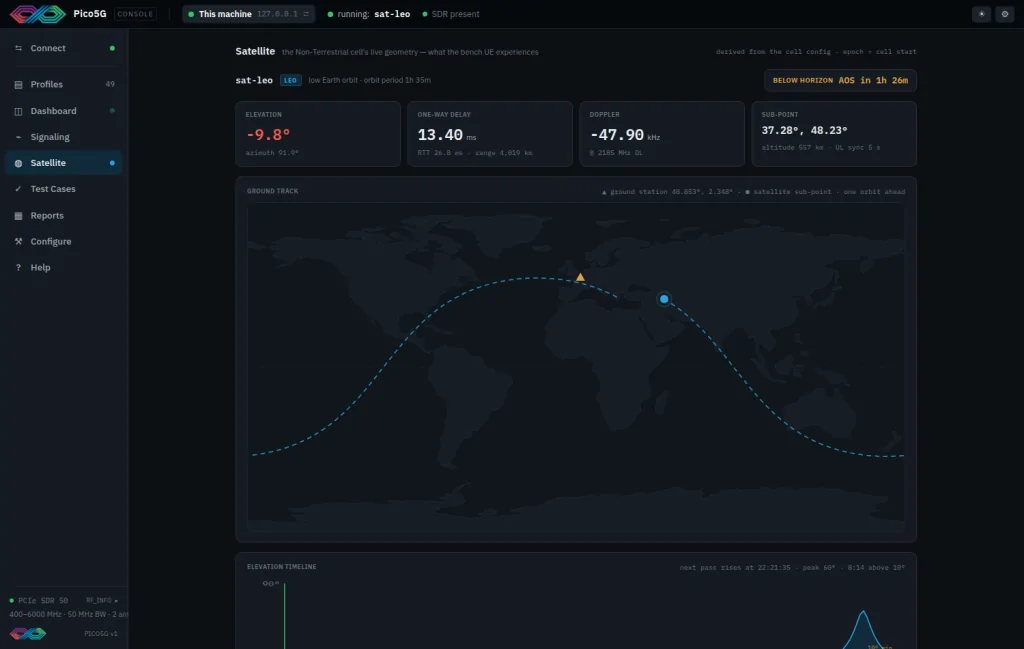
A satellite-link test bench built into the Pico5G box you already own. Fly real LEO, MEO and GEO passes over a live 5G NR or NB-IoT cell.
Learn more about the capabilities of the Pico5G Copilot and how it can help streamline your testing procedures.
Frequently Asked Questions
For a cloud model, yes — you bring your own Anthropic, OpenAI, or GLM key. You enter it yourself; it is stored on the unit, never displayed back, never written to the browser, and never visible to Nutaq support. Alternatively, bring no key: point the copilot at any OpenAI-compatible model server on your LAN or on the box.
Your question and the tool results the diagnosis gathers — configuration, signaling excerpts, KPIs: bench test data, no personal data. With a local/LAN model, nothing leaves the unit.
Two mechanisms: citations — every answer carries an expandable evidence trace with the exact tool calls and sources — and the benchmark, which seeds real faults on the real hardware and scores the copilot against the known cause. The exam now spans 58 seeded-fault cases and each engine's measured rating is shown in-product; the standing gate is ≥80%.
Honest answer: it depends on the model you bring — and the built-in benchmark exists exactly for this. Vet a candidate local model against the same seeded-fault exam before trusting it.
No. Any change requires your explicit approval, and the engine-enforced safety policy is checked after the approval. The only thing that runs unattended is the deterministic nightly sentinel, which you configure.