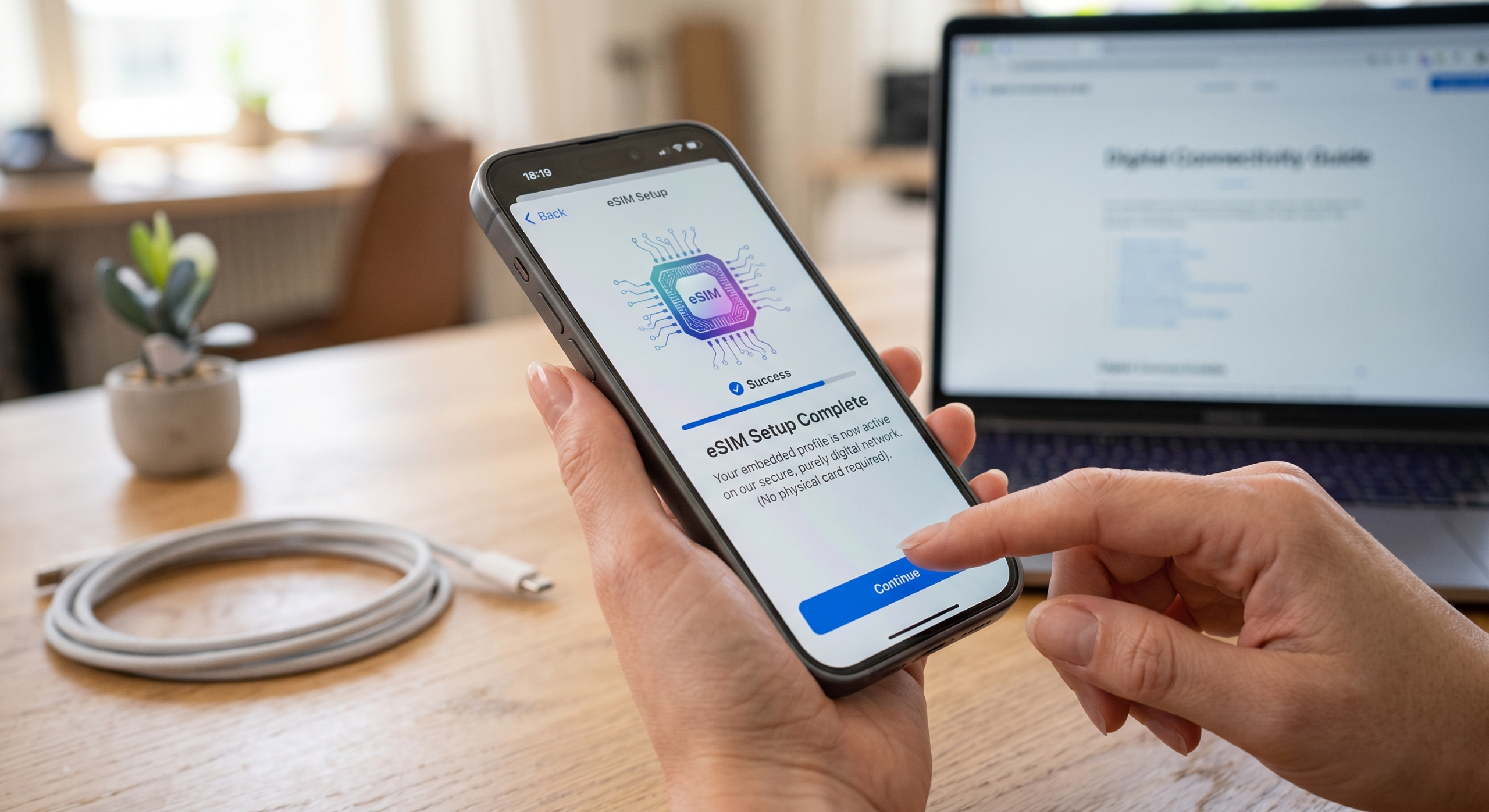
eSIM (embedded SIM, or embedded Subscriber Identity Module) device testing is more involved than it might initially appear. Unlike a physical SIM card that a technician can swap in or out, an eSIM is a permanent chip — an eUICC (embedded Universal Integrated Circuit Card) — soldered directly into the device. Network credentials are not stored on a removable card; instead, they are delivered and managed remotely as software profiles. For engineers validating eSIM-capable devices before launch, that architectural shift introduces a new layer of test cases that did not exist with traditional SIM cards.
Adoption is accelerating on multiple fronts. The GSMA predicts that 26–40% of smartphone connections will use eSIM in 2025.1 Beyond smartphones, eSIM is expanding into IoT (Internet of Things) devices, connected vehicles, medical wearables, and industrial wireless sensors — anywhere that remote profile management, compact hardware, and multi-network flexibility provide a practical advantage.2 As eSIM becomes a baseline expectation across these categories, the ability to validate eSIM behaviour thoroughly in a controlled lab environment is becoming a standard part of device development.
This article explains the architecture behind eSIM, where testing complexity comes from, and how the Pico5G Series supports eSIM device testing with a GSMA-certified test profile configured to work out of the box.
How eSIM Works: Architecture and Key Components
To understand what needs to be tested, it helps to understand how eSIM provisioning actually works. Three components handle the process:
- SM-DP+ (Subscription Manager Data Preparation Plus) is a remote server that stores operator network profiles and delivers them securely to devices. When a user activates a new plan or switches carriers, the profile originates from the SM-DP+.
- LPA (Local Profile Assistant) is software running on the device itself. It acts as the bridge between the eUICC and the SM-DP+ server — handling profile download requests, authentication exchanges, and profile installation instructions.
- eUICC is the physical chip on the device. It receives, stores, and activates profiles. Unlike a traditional SIM, it can hold multiple profiles simultaneously, though only one can be active at a time.
This architecture is governed by GSMA specifications. SGP.02 covers M2M (machine-to-machine) and IoT remote provisioning. SGP.22 applies to consumer devices such as smartphones and tablets. SGP.32, the newest specification, addresses IoT eSIM more specifically, with a streamlined provisioning model suited to devices with limited interfaces.3
Why eSIM Device Testing Is More Complex Than Physical SIM Testing
With a physical SIM, a device either connects to a network or it does not. The SIM card itself is a discrete, testable object. With eSIM, each step of the provisioning and management flow can fail independently:
- Profile download — the device must successfully contact the SM-DP+ server, authenticate, and retrieve the profile
- Profile installation — the LPA must correctly write the profile to the eUICC
- Profile activation — the device must enable the correct profile and register on the target network
- Profile switching — multi-profile devices must transition between carriers cleanly, without residual state from the previous profile
- End-to-end connectivity — post-activation, the device must authenticate with the network and pass data normally
Any one of these steps can fail in isolation. A device that downloads a profile correctly may still fail activation due to an authentication mismatch. A device that activates normally may exhibit problems during profile switching. Testing each of these stages requires a network environment that supports eSIM provisioning — not just a standard cellular connection.
Profile activation method also varies by device type. Smartphones and tablets typically activate via QR code scan — the QR code encodes the SM-DP+ server address and activation code. IoT devices, which often have no camera or display, use an LPA string entered programmatically.4
eSIM Device Testing with the Pico5G Series
The Pico5G Series runs on the Amarisoft software stack, which includes a GSMA-certified eSIM implementation compatible with any eSIM-capable commercial device.
The Amarisoft eSIM test profile is preconfigured with the following parameters:
- IMSI: 001010123456789
- Authentication algorithm: XOR
- Test PLMN: MCC 001 / MNC 01
This test PLMN matches the Pico5G’s default network configuration, which means no additional network setup is required to begin eSIM testing. Engineers can connect a device, initiate profile download via QR code or LPA string depending on device type, and proceed directly to validation — without reconfiguring the network side.
The Amarisoft eSIM implementation supports both QR code-based activation (consumer devices, smartphones) and LPA string-based activation (IoT devices and embedded modules without a display). Full technical details, including step-by-step provisioning procedures, are documented in the Amarisoft Tech Academy eSIM application note.
Use Cases: Who Needs eSIM Device Testing
The combination of eUICC hardware and remote provisioning is appearing in a wide range of product categories:
- IoT device manufacturers — validating LTE-M and NB-IoT modules with eSIM for remote asset tracking, smart meters, and environmental sensors
- Automotive — connected vehicles that require seamless profile switching as the vehicle crosses network or regional boundaries
- Medical devices — wearables and remote patient monitoring equipment where compact hardware and remote manageability are requirements
- Industrial wireless — factory and field sensors that must operate on multiple carrier networks without physical access for SIM changes
- Smartphone and tablet development — pre-certification validation of SGP.22-compliant consumer eSIM behaviour
In each case, validating the full provisioning flow in a controlled lab environment — before devices reach the field or enter carrier certification — reduces the risk of connectivity failures that are difficult to diagnose after deployment.
Conclusion
eSIM introduces meaningful testing complexity compared to physical SIM-based devices. Engineers must validate not just network connectivity, but the entire provisioning chain: profile download, installation, activation, switching, and end-to-end data flow — with the correct behaviour varying depending on whether the device follows SGP.02, SGP.22, or SGP.32. The Pico5G Series, running the Amarisoft software stack with a GSMA-certified eSIM test profile preconfigured for MCC 001 / MNC 01, provides a direct path to eSIM device testing without requiring custom network configuration.
For engineers developing eSIM-capable devices across IoT, automotive, medical, or consumer categories, the Pico5G is designed to support that validation from a single, compact platform.
Explore the Pico5G Series at nutaq.com/pico5g-series/, or contact Nutaq to discuss your specific eSIM testing requirements.
Frequently Asked Questions
Q: What is eSIM device testing and why does it matter?
eSIM device testing is the process of validating the full provisioning and connectivity lifecycle of a device that uses an eUICC (embedded Universal Integrated Circuit Card) rather than a removable physical SIM. Because eSIM profiles are delivered remotely via an SM-DP+ server and managed on-device by an LPA (Local Profile Assistant), there are multiple independent steps — profile download, installation, activation, switching, and end-to-end authentication — that can each fail independently. Testing ensures a device handles all of these correctly before it reaches the field or enters carrier certification.
Q: What GSMA specifications govern eSIM, and which applies to IoT devices?
The GSMA has defined three primary eSIM specifications. SGP.02 covers M2M and IoT remote SIM provisioning. SGP.22 covers consumer devices such as smartphones and tablets. SGP.32 is the newest specification and is specifically designed for IoT eSIM, providing a more streamlined provisioning model suited to constrained devices with limited user interfaces. The applicable specification depends on the device category being tested.
Q: How does the Pico5G Series support eSIM device testing?
The Pico5G Series runs on the Amarisoft software stack, which includes a GSMA-certified eSIM implementation. It comes preconfigured with a test PLMN of MCC 001 / MNC 01, which matches the Amarisoft eSIM test profile (IMSI 001010123456789, XOR authentication). This means engineers can begin eSIM device testing — including profile download, activation, and connectivity validation — without additional network configuration. Both QR code activation (for smartphones) and LPA string activation (for IoT devices) are supported.
Q: What is the difference between QR code and LPA string eSIM activation?
QR code activation is used primarily with consumer devices such as smartphones and tablets. The QR code encodes the SM-DP+ server address and an activation code; the device’s camera scans it to initiate profile download. LPA string activation is used with IoT devices and embedded modules that have no camera or display — the same information is entered programmatically via a text string. Both methods initiate the same underlying provisioning process; the difference is only in how the activation data is delivered to the device.
Q: What types of devices and industries benefit most from eSIM testing in a lab environment?
eSIM testing in a controlled lab environment is particularly valuable for IoT device manufacturers working with LTE-M and NB-IoT modules, automotive teams developing connected vehicles that need reliable profile switching across networks, medical device developers building wearables and remote monitoring equipment, industrial wireless sensor manufacturers, and smartphone or tablet teams doing pre-certification validation. In all of these cases, identifying provisioning or connectivity failures in the lab — before field deployment or carrier testing — is significantly less costly than diagnosing them after the fact.
───────────────────────────────────────────────────────────
References
- “Trusted Connectivity Alliance: eSIM Industry Insights 2024.” Trusted Connectivity Alliance. Accessed June 22, 2026. https://trustedconnectivityalliance.org/wp-content/uploads/2025/03/TCA_INDUSTRY-INSIGHTS_FINAL.pdf
- “eSIM Compliance Report 2025.” GSMA. December 4, 2025. https://www.gsma.com/solutions-and-impact/technologies/esim/gsma_resources/understand-the-state-of-esim-compliance-in-2025/
- “eSIM.” Wikipedia. Accessed June 22, 2026. https://en.wikipedia.org/wiki/ESIM
- “What is an eSIM Card & How Does it Work?” AT&T. Accessed June 22, 2026. https://www.att.com/wireless/what-is-esim/